
Solve the puzzle
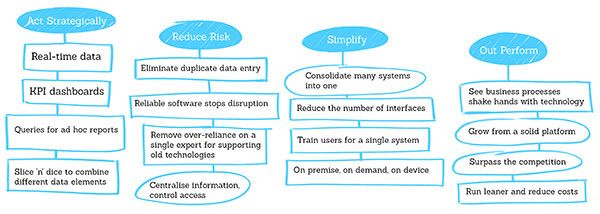
Effective organizations seamlessly combine business processes and software. Workflows are used to represent processes in ERP software and create competitive advantage through:
- instilling consistency
- secured access to transactions
- speed of execution
- elimination of manual workarounds
- improving productivity
- preventing user error
- hosting all business information on a single application
- alerting users when pre-defined triggers occur
- faster reaction times
A reliance on disparate systems or spreadsheets is the opposite, and puts your organization at a competitive disadvantage.
For organizations in regional locations like Bendigo ERP is essential because it provides and equal footing on the big stage when it comes to competing nationally and internationally.
Take your business to the next level with ERP
Do you have a 21st century business reliant on 20th century software? The challenges are many:
- Multiple warehouses and bins
- Batch or serial number management
- Inaccurate inventory levels
- Customer relationship management
- Taking the guesswork out of sales forecasting
- Duplicate invoices and payments
- Poor or unpredictable cash flow
- Multi currency requirements
- Job or product costing, WIP tracking, variance analysis
- Slow in closing the books
- Spending too much time reconciling
- Lack of budget control and approvals
- Over reliance on manual journals
- Lack of visibility and poor reports
But the technology to overcome them is out there!
Implementation time for regional clients in Bendigo and Central Victoria is typically between 1 and 3 months, but can be within a month or closer to a year depending on requirements. Cost is an important consideration, these are some of the elements to consider:
- Hardware, hosting or cloud fees
- User licenses
- Consulting fees
- Indirect and backfilling costs to cover the normal day-to-day jobs of employees seconded to the project
- The number of legal entities, production facilities and warehouses, and their locations
- The degree to which an out of the box solution can be applied, or, put another way how many add-ons or non standard programs will be required
- If project management should be full or part-time
- Whether the implementation will be purely technical, or an opportunity to re-engineer business processes as well
This last point is important, but often overlooked. Technical improvements alone are a cost saving good reason to implement ERP, but maximum benefits come from streamlining processes first. For example, managers often waste time on mundane tasks such as signing purchase orders or approving special sales order discounts. Instead of reviewing every order, ERP software can filter the high value ones and automatically route them to the right level of managent for on-line approval. ERP implementations therefore are an investment that unites business and technology, rather than an IT project.
Project buy in from key stakeholders in the business is also critical to a successful implementation, and we recommend taking a closer look at the business processes as a meaningful way to engage them from the kick-off. As the project progresses the stakeholders gain confidence from seeing their input reflected in the technology which engenders a sense of ownership in the new system. The result of this partnership between Look, Listen, Do and your key personnel produces positive advocates of your new ERP system and promotes user acceptance across the entire business.
Why implement ERP?